What we make visible

written: November 15, 2026
Published: November 18, 2026
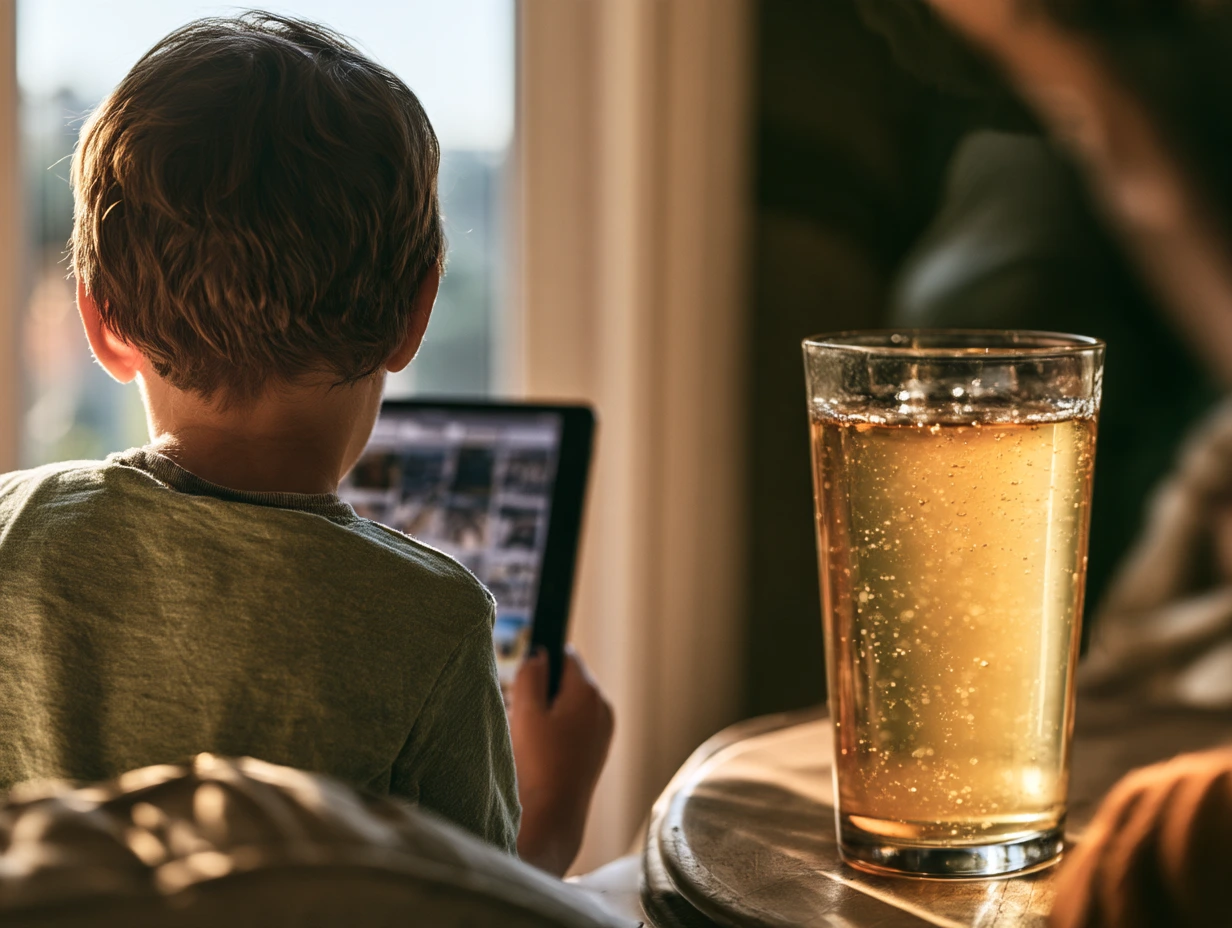
We flew to Europe in October. Twenty-four hours each way, with a six-year-old and a three-year-old. We used screens. We used them without guilt or apology, because that is what a twenty-four-hour flight with small children requires, and anyone who tells you otherwise has not done it.
What I did not expect was the Germany effect.
My husband couldn’t wait to give our children apple juice with sparkling water — the drinks of his own childhood, the specific pleasure of reviving something he had loved. And so for three weeks, our children drank apple juice and sparkling water with every meal, surrounded by grandparents who were delighted to also give it to them. It was lovely, it was also the beginning of what I was quietly dreading on the flight home.
I boarded the return journey fully prepared for a difficult re-entry. Two children who had been on screens for a month. Who had been drinking whatever they wanted. Who had been sleeping differently, eating differently, running on a different schedule in a different language in a different house. I was braced for the unravelling.
What happened instead was very surprising.
{{Section-break}}
Before we landed, I bought each of them a couple of really cool water bottles at Amazon. I thought it was going to be a good invitation. For my daughter: one with unicorns, one with mermaids. For son: dinosaurs, PAW Patrol. Something new, something theirs, something that made water feel like the exciting option rather than the boring default. It was a small thing, I can tell you, it worked immediately!.
The screens required more thought.
My husband and I got aligned before we walked through the door. We were both going to hold the same line. We were both going to be comfortable with the discomfort that comes in the first days when a child reaches for something that is no longer there. We were not going to cave separately, in a moment of exhaustion, and undo what the other one had held. That alignment, being genuinely on the same page before the moment arrived, not negotiating it in real time while a six-year-old was upset in front of us, was probably the most important decision we made.
The first thing I did was change the passwords. My six years old already knew the code for my phone and the iPad. That was the simplest version of the problem: access was too easy, and ease is what habits are built from.
Then I had a conversation with her.
I told her what I know to be true, in the plainest words I could find for a six-year-old: that too much screen time affects how the brain develops, that her brain was going to need some time to build back up, and that we were going to do it together, through reading, writing, creative play, and time away from the screen. I told her that her brain could grow back and that she was going to be part of making that happen.
She looked at me very seriously and said she was not going to watch TV anymore.
And she has not. It has been four weeks.
{{Section-break}}
What has happened in those four weeks is the thing I want to write about, because it is not what I expected.
I expected negotiation. I expected the grief of a child who has lost access to something they want. I expected a difficult first week followed by a gradual adjustment.
What I got was boredom, and then something better.
They were bored, very uncomfortably bored. The specific restlessness of children who have had their default entertainment removed and have not yet remembered what else they can do. I did not rescue them from it, I let it sit there, because boredom is not a problem to be solved. It is the moment just before imagination arrives.
And imagination did arrive!. Within a few days they were in their rooms building something, inventing games, playing together in the way that children play when nobody is directing them. My daughter has been writing and painting. My son follows her everywhere and tries to do what she does. We have eaten dinner without a screen at the table every night. We have had more conversations at that table than we have had in months. Their behaviour has improved massively. The low-grade tension that screens create, the dysregulation that arrives after a session ends, the difficulty of transitioning from screen time to anything else: all of it, gone!.
Watching too much television is a habit. And not watching it is also a habit. The question is simply which one you build first, and which one you make easiest to reach for.
{{Section-break}}
In most homes, the most prominent feature of the main living space is a large screen. It is the focal point of the room. It is what your eye goes to when you walk in. It is what the furniture is arranged around. It is the most visible, most accessible, most prominent option in the space.
And we wonder why it is what children reach for first.
Children do not choose what they value. They choose what they can see. What is in front of them, at their height, within reach, in the room they spend time in. They move toward what has been made easy and visible. This is not weakness or lack of willpower. It is how children work. It is, honestly, how most adults work too.
So if screens are what we want them to reach for less, the answer is not primarily about willpower or rules or conversations, though all of those matter. The answer is also about architecture. What is at their eye level. What is in the basket on the shelf they walk past. Whether the books are on a shelf they can reach or in a cupboard they have to ask an adult to open. Whether the paper and the pencils and the paint are set up on the table or stored away in a drawer.
What we make visible, they reach for. What we put away, they forget.
I have been rearranging our house with this in mind. Books at their height, art supplies in a basket on the low shelf in the living room, paper on the table. The screen is still there; I am not arguing for its elimination, and a good film watched together is a big part of how stories and characters and the world get transmitted to children. But it is no longer the most prominent thing in the room. It is no longer the default.
{{Section-break}}
I do not share this as a parent who has solved anything. I share it as one who was surprised by how much was possible, and how quickly, once the conditions changed.
The Europe trip was not a detour from our normal life. It turned out to be the interruption that showed me what normal life had quietly become. That sometimes is what a change of environment does; it removes the habits so completely that when you come home you can see them clearly for the first time, and decide which ones you want to bring back inside.
We brought back the apple juice once, as a treat. They were delighted. Then they went back to their water bottles without being asked.
Habits are not what children are. They are what children have been given the conditions to build. That part is ours.
— Sabrina